



Nanman Screen - Kobe City Museum
It is a type of screen made in Japan from the late 16th century to the mid-17th century, mainly depicting scenes of communication with Portugal and Spain. This important cultural property created by Kano Uchiyama uses the technique of coloring gold on paper and consists of six pieces. It is currently collected at the Kobe City Museum. The creative background is closely related to Japan's foreign exchanges at that time. In the late 16th century, with the colonial expansion of Portugal and Spain in Asia, Western European countries began to enter Japan's trading circle, and the Japanese at that time referred to them as the "Southern Barbarians". From this work, we can see how Japanese people at that time understood and expressed their communication and interaction with foreign countries through art.
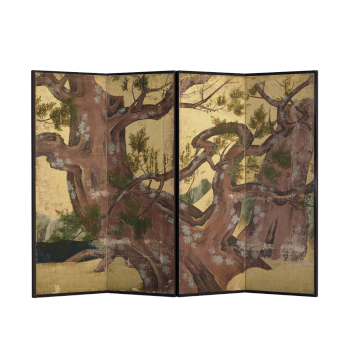
Kano Nagatoku's "The Cypress Screen" (right) - Tokyo National Museum
It is one of the representative works of the famous Japanese painter Nagatoku Kano during the Momoyama period, known for its magnificent obstacle screen painting style. Created in the late 16th century, it is an outstanding representative of art from the Azuchi Momoyama period in Japan. The background of the painting is almost covered with gold foil, highlighting the vigorous branches of the cypress tree. Kano Nagatoku inherited the painting style of his grandfather Kano Motonobu, blending ink paintings from China with colorful paintings from Japan, creating a powerful yet magnificent painting style that was deeply loved by military commanders at that time., Currently housed in the National Museum of Tokyo, it is an indispensable and valuable resource for studying the history of Japanese painting.

Kano Nagatoku's "The Cypress Screen" (left) - Tokyo National Museum
It is one of the representative works of the famous Japanese painter Nagatoku Kano during the Momoyama period, known for its magnificent obstacle screen painting style. Created in the late 16th century, it is an outstanding representative of art from the Azuchi Momoyama period in Japan. The background of the painting is almost covered with gold foil, highlighting the vigorous branches of the cypress tree. Kano Nagatoku inherited the painting style of his grandfather Kano Motonobu, blending ink paintings from China with colorful paintings from Japan, creating a powerful yet magnificent painting style that was deeply loved by military commanders at that time., Currently housed in the National Museum of Tokyo, it is an indispensable and valuable resource for studying the history of Japanese painting.

Japanese Ghost Warrior Mask
It is a part of traditional Japanese samurai culture, often associated with Noh drama and warrior battle scenes. These masks typically depict images of ghosts or evil spirits, playing important roles in traditional Japanese theatrical art. One of the most famous ghost masks is the "Prajna" mask, which symbolizes jealous and resentful female monsters, transformed into ghosts due to jealousy. The production of masks is very particular, usually carved from wood and colored, and this process is called "face slapping". These masks are an important part of Japanese culture and history, reflecting the Japanese people's reverence for supernatural phenomena and their unique pursuit of beauty.

Japanese samurai helmet
Also known as bowl gold, it is a helmet worn by the Japanese samurai class in battles and ceremonies. Not only is it an important component of samurai equipment, but it is also a symbol of Japanese culture and art. The designs are diverse, ranging from simple conical shapes to complex decorative helmets, reflecting the social status and personal taste of warriors. In battle, Bo Jin not only provides protection, but also serves as a deterrent to the enemy. The design aims to protect the warrior's head from damage from swords and arrows. The shape and decoration of the helmet help identify enemies and allies on the battlefield, while also reflecting the bravery and dignity of warriors. It is a part of Japanese history and culture.

Musashino Plain Six Curve Screen
It is one of the classic themes in Japanese art. In Japanese painting, there is a specific category called "Meisaku" that specifically depicts places famous for their poetry or literary stories. Musashino is such a place, mentioned in "Ise Monogatari" as a collection of lyrical stories from the 10th century. It usually consists of a pair and is colored with gold foil paper, showcasing the Japanese art style from the 17th to the 18th century. These screens are not only renowned for their beautiful natural landscapes, but also appreciated for their rich cultural and historical significance. It usually depicts Mount Fuji and the surrounding autumn grass, showcasing the peaceful beauty of autumn in Japan

Japanese traditional instrument shoulder drum (brown)
Also known as the Hetai drum, it is one of the traditional Japanese percussion instruments with a long history and profound cultural heritage. Originating around 500 BC, it was first known as TSUDUMI and recorded in the Japanese myth "Kojiki". Not only musical instruments, but also an important part of Japanese culture, creating a sacred atmosphere in sacred places and important ceremonies with its unique low pitched sound and resonance. In Japan, the taiko is not only a musical performance, but also a symbol of community unity and cultural heritage. Its sound is closely connected to Japan's nature, history, and people's lives.

Japanese traditional instrument shoulder drum (red)
Also known as the Hetai drum, it is one of the traditional Japanese percussion instruments with a long history and profound cultural heritage. Originating around 500 BC, it was first known as TSUDUMI and recorded in the Japanese myth "Kojiki". Not only musical instruments, but also an important part of Japanese culture, creating a sacred atmosphere in sacred places and important ceremonies with its unique low pitched sound and resonance. In Japan, the taiko is not only a musical performance, but also a symbol of community unity and cultural heritage. Its sound is closely connected to Japan's nature, history, and people's lives.
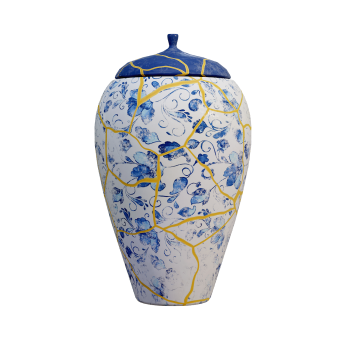
Japanese gold vase
It is a representative of traditional Japanese craftsmanship, which involves re bonding broken ceramic fragments with gold powder or paint to give them new life and beauty. The term 'jinzao' comes from the Japanese word 'jin 継ぎ', meaning 'repair with gold'. This technique is not just about restoration, but also an art form that views fragmentation as a part of life, connecting fragments with gold threads to showcase a unique aesthetic. High quality ceramic materials are usually selected, carefully designed and made, then intentionally broken and repaired. The aesthetic concept of gold vase corresponds to the Japanese culture of "wabi sabi", which appreciates the beauty of imperfection, impermanence, and incompleteness.
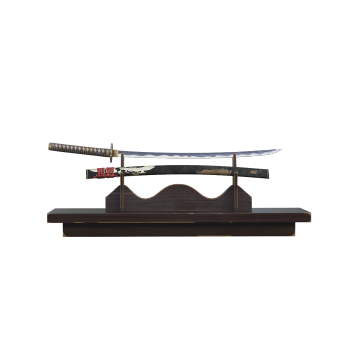
Japanese samurai sword
Also known as the Japanese sword, it is one of the best traditional weapons in Japan, renowned for its exquisite craftsmanship and sharp cutting edge. The blade is forged from high carbon steel and undergoes repeated folding and tempering to form a unique patterned steel, which not only looks beautiful but also enhances the strength and toughness of the blade. The blade is incredibly sharp and can easily cut paper and other objects, showcasing the outstanding performance of a samurai sword. The handle part adopts traditional Japanese handle making techniques, usually made of wood or bamboo, wrapped with silk thread to ensure stability and comfort during grip. As a display of art, it is also a tribute to Japanese sword culture.

Japanese torii
It is an iconic annex building of Japanese shrines, mainly used to distinguish the divine realm from the secular realm where humans reside, symbolizing the entrance to the divine realm. It usually consists of two pillars and two crossbeams, and sometimes hangs a plaque with inscriptions on it. It is usually made of wood and painted with raw paint. The color is usually vermilion, which is believed to have the power to dispel demons, like a monk's barrier. In Japan, people believe that torii can fulfill their wishes, so the custom of worshipping torii has been popular since the Edo period. Torii is not only a part of the shrine, but also an important symbol of Japanese culture.

Japanese mythology legend: The Great Tengu Mask
It is a traditional Japanese mask art with distinct cultural characteristics and profound historical background. Da Tian Gou is a creature in Japanese mythology, often depicted as a mysterious being with a long nose, a red face, and wings. In folklore, Tengu is the guardian of the mountains and forests, possessing supernatural powers. Sometimes it is considered a mischievous elf, while other times it is seen as a symbol of wisdom and power. The design is usually very exaggerated, with a long and curved nose being its most prominent feature, representing the arrogance and conceit of Tengu. Symbolizing the reverence for nature and supernatural forces in Japanese culture. It has also become one of the symbols of Japanese culture.

Japanese clogs
Also known as "Xiana", it is one of the traditional Japanese footwear with a long history and unique cultural significance. Originating from the Heian period (794-1185), it was initially used as footwear for warriors and nobles, and gradually became popular among the general public. The design is simple and practical, usually consisting of a wooden base, two pieces of wooden shoelaces (called "noses"), and shoelace fixing devices. The bottom plate is usually made of sturdy wood, such as beech or oak, which can provide good support and durability. In Japanese culture, clogs are not only shoes worn in daily life, but also decorations for festivals and special occasions. It is one of the symbols of Japanese culture.

Ancient Japanese Warrior Armor - Spanish National Army Museum
Also known as Japanese armor, it was a type of armor in Japan during the Edo period (1603-1868). It is part of the collection of Romero Ortiz, and its 1888 catalog is related to the background of Daniel Dato and the Philippine War. In ancient Japan, warriors or samurai were military elites who served daimyos or feudal lords. Their armor, as the foundation of their defensive clothing, consisted of different components covering the entire body, which evolved into forms of great display and precious decoration, especially during the Edo period. It is currently housed in the National Army Museum of Spain.

Edo Scene Screen - Edo Tokyo Museum
This screen painting collected by the Edo Tokyo Museum depicts Edo (now Tokyo) before the Great Fire of the Ming Dynasty in 1657. In addition to depicting the scenery of Edo, the painting also showcases daily life in Edo and specifically depicts traditional activities related to General Tokugawa Iemitsu, such as the groom's head ceremony in Kawagoe and eagle hanging and pig hunting activities in the suburbs. These activities reflected the social culture and the life of the samurai class at that time. There are various speculations in the academic community about the creation time of this screen painting, but there is still no consensus.

Popular Models

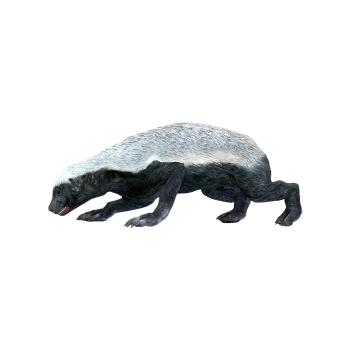
Honey Badger (3D animated model)
192 View
Guinea fowl (3D animated model)
163 View

Wild Goose (3D animated model)
185 View

Red Fox (3D animated model)
153 View
Random Model

A Starbucks coffee cup
468 View

Chestnut 3D model
1016 View

Spanish Goat
1525 View


Japanese gold vase
776 View

17th century Dutch Bert ship
898 View

Chinese cloisonn é vase
1130 View